Don’t believe a word of Trump’s baloney
There he was, sitting next to PM Narendra Modi, gnashing his teeth and lying through them.
The Taliban has alleged that Pakistani military airstrikes targeted civilian areas in eastern Afghanistan, killing and injuring dozens of civilians as tensions between the two countries continue to escalate.




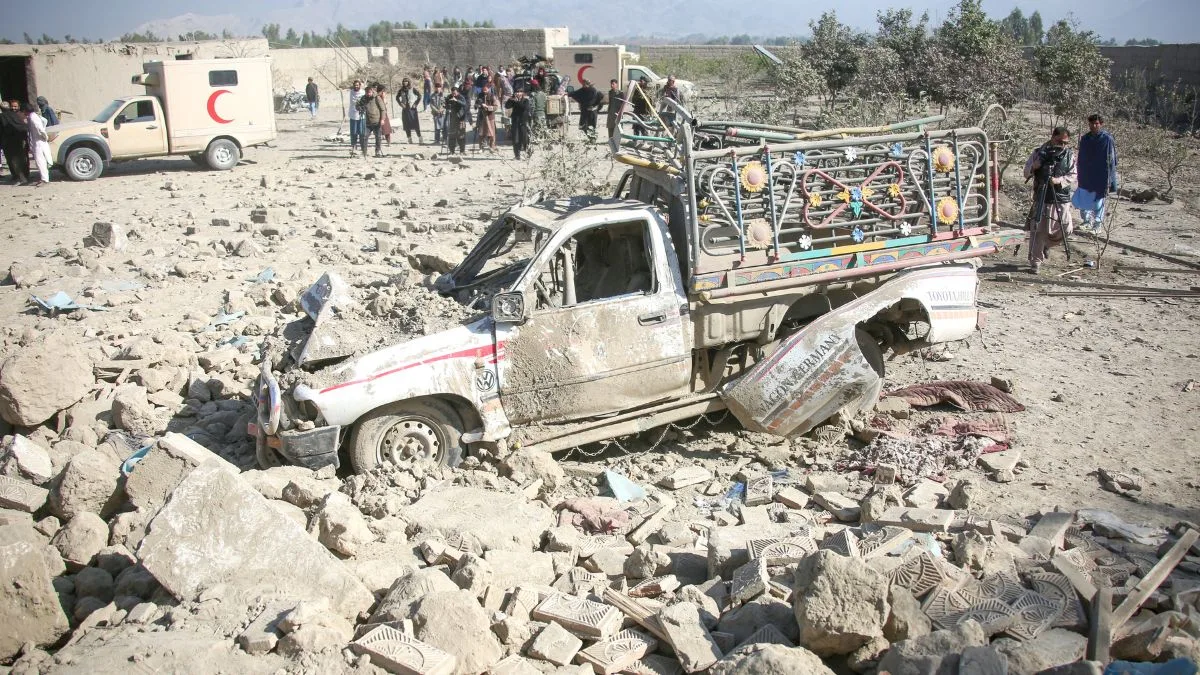
A damaged vehicle lies amid debris after a reported airstrike in Afghanistan's Nangarhar Province on February 22, 2026. Afghan government spokesperson Zabihullah Mujahid said Pakistani military airstrikes on border areas caused dozens of casualties. (Photo: Xinhua via IANS)
Pakistan carried out fresh cross-border airstrikes inside eastern Afghanistan, killing 36 civilians and injuring 163 others, according to the Taliban administration, which accused Islamabad of targeting residential areas and rescue workers during overnight attacks.
The latest strikes threaten to further strain already fragile ties between Pakistan and Afghanistan. While the Taliban condemned the operation as an attack on civilians, Pakistan maintained that the action was part of an intelligence-based operation launched after a series of militant attacks inside its territory.
Advertisement
Taliban deputy spokesperson Hamdullah Fitrat said the strikes hit parts of Paktia, Paktika and Kunar provinces late Sunday.
Advertisement
“According to the reports available thus far, the attacks carried out last night resulted in the martyrdom of 36 civilians, including women and children, while 163 others sustained injuries. Three residential houses were completely destroyed,” Fitrat said in a statement posted on social media.
According to the Taliban, one strike hit a civilian home in Mandokhail village in Chamkani district of Paktia province, killing an elderly man and a child while injuring other members of the family.
Fitrat alleged that Pakistani aircraft struck the same location again after residents gathered to rescue survivors.
“Subsequently, when local residents gathered to conduct rescue operations, the area was bombed for a second time, resulting in the martyrdom of 28 villagers and injuries to 158 others,” he said.
Another strike reportedly hit a residence in Walust village in Giyan district of Paktika province, where six people, most of them women and children, were killed.
In Barolo village of Manogai district in Kunar province, a residential house was destroyed, though no casualties were reported, according to the Taliban.
Taliban spokesperson Zabihullah Mujahid separately condemned the operation, calling it a “cowardly act of aggression”.
Pakistan defended the cross-border action, saying its security forces had conducted a “well planned intelligence based ground operation” supported by aerial strikes.
Information Minister Attaullah Tarar said the operation was launched after a series of recent militant attacks inside Pakistan, including incidents in Khyber Pakhtunkhwa, Balochistan and an assault on a paramilitary installation in Karachi.
Pakistani daily Dawn reported that militants attacked the headquarters of the Pakistan Sindh Rangers in Karachi’s Gulistan-i-Jauhar area on Saturday night. According to the report, three Rangers personnel and three attackers were killed. An affiliate of Jamaat-ul-Ahrar, a splinter faction of the Tehreek-e-Taliban Pakistan (TTP), claimed responsibility, Al Jazeera reported.
Former US Ambassador to Afghanistan Zalmay Khalilzad criticised Islamabad following the strikes, saying Pakistan had once again chosen military action over dialogue.
“Ignoring the calls from around the world and from many Pakistanis for negotiations to resolve their differences with their neighbour, once again Pakistan has attacked Afghanistan, again killing and injuring many. I have consistently condemned Pakistan’s killing of innocent Afghans. I do it again today,” Khalilzad wrote on X.
Questioning Pakistan’s broader objectives, he asked whether Islamabad was interested in a negotiated settlement or pursuing other strategic goals in Afghanistan.
“If these are actual Pakistani objectives, it’s no surprise that the Pakistani establishment does not articulate them publicly,” he said.
The latest strikes come less than three weeks after Pakistan launched airstrikes against what it described as militant hideouts inside Afghanistan.
Border tensions have remained high for months, with repeated exchanges of fire and failed diplomatic efforts to restore calm. China hosted talks between Islamabad and Kabul in April, after which both sides said they would work to reduce hostilities, but the latest violence has cast fresh doubt over those efforts.
Advertisement